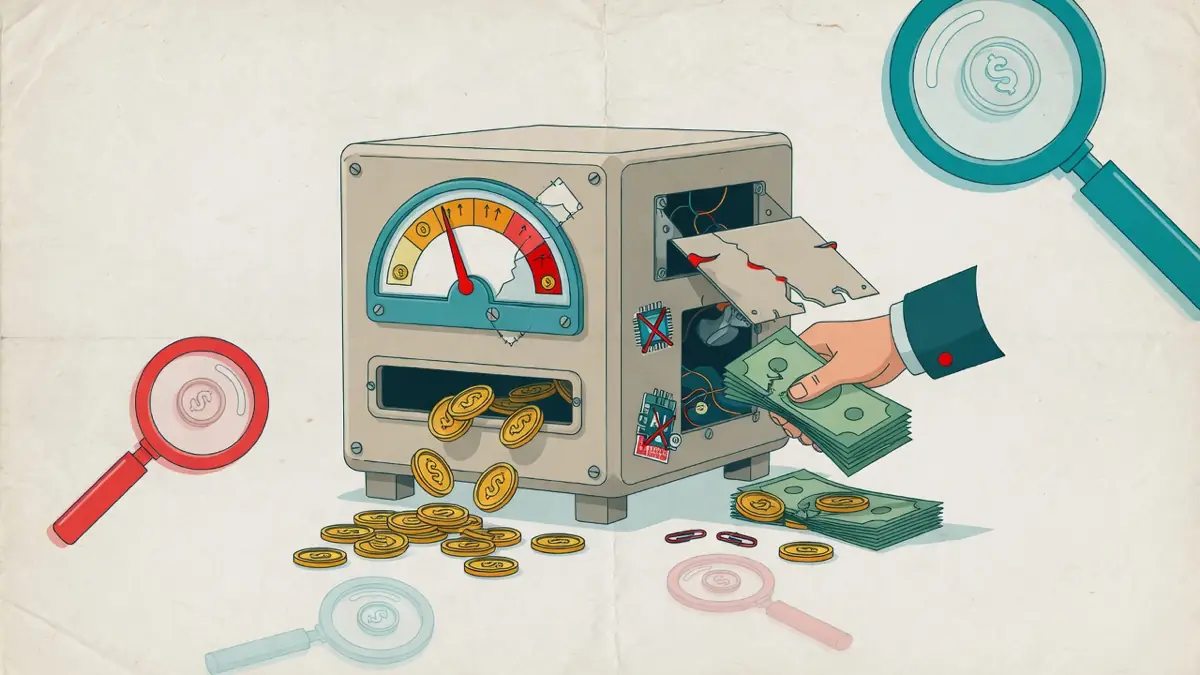
You've probably seen the invite. Somebody flashes a screenshot — an account curve climbing day after day — with a line like, "I'm running an AI trading bot, 1 to 2 percent a day, I literally make money in my sleep." It sounds like you've finally found the lazy lane: no chart-watching, no need to understand the market. But the moment you're tempted, you've stepped onto a script that was written long before you arrived. This piece pulls that script apart so you can see what each step is betting you'll believe.
- If it promises "guaranteed / principal-protected / high yield / risk-free," whether it's dressed up as AI, quant, or arbitrage, you can basically flag it on the spot — that promise itself doesn't hold up in finance.
- Real quant firms earn on management fees; they don't go around recruiting retail investors to wire money into some unfamiliar platform. Anyone who recruits you wants your principal.
- A smooth withdrawal doesn't prove it's real. A small early payout is bait, and some schemes even hand back your principal plus a little "profit" so you return with more. Real vs. fake comes down to who operates it, whether it holds a local licence, and whether its trades can be checked somewhere independent; getting your money out is for stopping the loss, not for verification.
What it looks like when it lands in front of you
This scam rarely leads with money. It first sells a sense of "tech" and "ease." The script recycles the same few lines, and you've probably heard them:
- "We use an AI quant model, the machine decides the entries and exits, 1–3% a day, guaranteed — it earns whether the market goes up or down."
- "This is cross-exchange arbitrage: the same coin has a price gap across exchanges, the bot buys on one side and sells on the other, pocketing the spread risk-free."
- "You don't have to understand anything, just put the money in and ride the bot on full autopilot — we've got hundreds of people all earning."
Notice how the script is built: it severs "making money" from "what you need to understand." It hammers home that you don't need to learn, watch, or worry about risk — just pay, and leave the rest to "a smarter system." That promise of "outsource your brain and still get paid" is exactly where the danger lives, because it gets you to set down every bit of caution you should have had.
Why "guaranteed" alone is a death sentence
You don't need to understand quant trading, and you don't need to read any chart. Grab one piece of financial common sense and you can see through most of these: return and risk are bound together — nobody can pry them apart. A strategy that genuinely earns over time will have losing stretches and drawdowns; that's a basic law of markets. Something claiming to be "guaranteed, principal-protected, risk-free whether the market rises or falls" is claiming to have bypassed that law — and that can't be done.
Now take "risk-free arbitrage" specifically. Price gaps between exchanges do exist, and professional teams do run this kind of arbitrage, but it is never "risk-free": the spread vanishes in an instant, you carry transfer-time and withdrawal-delay risk, trading fees eat into the profit, and one jolt in the market can flip the gap against you. The people who actually do this are busy racing against time and fees — they have neither the bandwidth nor any reason to fill a group chat recruiting total strangers to "arbitrage together."
Flip it and ask the most basic question
If there really were a machine that earned a point or two a day, reliably and risk-free, any institution — or anyone with a bit of money — would borrow to buy it outright and get rich quietly. They would never go around recruiting "downline" and begging strangers to deposit. The better the thing, the less it needs to recruit; the harder it pushes to recruit, the clearer it is that the money it earns is the money of the people it recruits.
The three most common variants
The shell changes its look every year; the core is just a few things. Recognize these three and almost every variant slots into one of them:
Fake quant platform: deposits flow in, withdrawals don't
You get a professional-looking website or app, with an account, "live profits," and support. After you deposit, the number in your account climbs obediently every day. The problem only erupts the moment you try to withdraw: first they have you pay "income tax," then "your account tripped risk control, top up margin," layer after layer, until you stop paying and the platform vanishes or blocks you. Every "profit" you saw was, start to finish, a number typed into a back end.
Fake "copy-trade / AI trading" app
Headlined as "one-tap copy a pro" or "bind an AI to auto-trade." Some lure you to deposit into its own wallet (effectively a fake exchange); the nastier ones get you to authorize it to operate your real exchange account or wallet. Once it has your API keys or a wallet approval, it can move your assets out right under your nose. Remember: handing your trading access to an unknown app is handing the safe's key to a stranger.
"Profit-flexing" group hype on Telegram / WhatsApp
They pull you into a group of hundreds where people post profit screenshots all day, someone shouts "withdrew again today," and a "mentor" runs scheduled market analysis. Almost all of the buzz is staged: screenshots are faked, and the active "long-time earners" are usually shills or bots. The group's only function is to drown your doubt in herd pressure — to make you feel "everyone's earning and I'm the only one hesitating."
It's really a Ponzi and pig-butchering in new clothes
Don't let "AI" and "quant" intimidate you — a lot of these schemes, peeled open, are old scams in a new skin.
When it "pays the so-called returns of earlier people with the money of later people," it's by definition a Ponzi scheme — there's no real trading earning anything, it survives purely on a steady stream of new entrants, and it collapses and runs the moment the new money stops. That's the same machine as "fake high-rebate, locked-staking high-yield," just with the selling point swapped from "rebate" to "AI quant." Further reading: fake high-rebate & Ponzi schemes.
And when it first builds a "relationship" with you or takes you on as a "student," then slowly leads you into this "insider, guaranteed-profit channel," that's the standard script of pig butchering — the "AI quant platform" is often just the final stage where the pig-butchering scam harvests you. Further reading: pig butchering & "mentor" trade calls.
Red-flag checklist
Hit any one of these and it's basically this scam
- Promises of guaranteed / principal-protected / high yield / fixed daily return / risk-free — this one alone is enough.
- You were pulled in by a stranger or online acquaintance, especially with "limited spots" / "closes today" pressure.
- Funds don't go to your own exchange or wallet, but get deposited to a platform, address, or person they designate.
- They want you to authorize API keys, or import a private key or seed phrase into some copy-trade / AI app. No legitimate service ever asks for your private key or seed phrase.
- Withdrawals come with prerequisites: "pay tax, top up margin, unfreeze fee, system upgrade" — pay first, then you can withdraw.
- The group is all profit screenshots and mentor calls, but nobody can give you any real, independently verifiable information.
Three ways to verify it yourself
When you're not sure, don't ask the people in the group (they're all in on it). Run these three gates yourself:
- Check whether the platform is a real exchange. These "quant platforms" are usually a standalone site or app nobody's heard of, not in the mainstream app stores and with no legitimate background you can find. For how to judge, see how to judge whether an exchange is legit; to check whether a domain is a spoof, run it through the official domain checker. You can also confirm whether a firm is a registered broker-dealer via FINRA BrokerCheck or check the SEC and CFTC registers.
- Gut-check the returns with common sense. Compound the daily return it promises and you'll find it implies multiplying many times over in a few months — any "machine" that could do that would not need your little pile of principal. A return that's absurdly high is the most direct alarm there is.
- Pull your principal out to stop the loss, not to test the platform. Even if you can withdraw small amounts early, don't add more — go straight to trying to withdraw your principal and profits all at once. The moment you're stuck on "pay tax / top up margin first," the answer is already clear; and if it does come out, don't treat that as proof and put it back in — scams repay money to buy your trust too.
The one-line rule
There's nothing wrong with wanting passive income; what's wrong is handing your money to a "system" you can't control and can't verify. If you really want exposure to the market, do it through a major, regulated exchange in a way you understand and where you can withdraw your money anytime — rather than outsourcing both your brain and your wallet to someone else.
Already invested — what now
If you've already put money into one of these, take a breath and work the order below — don't rush to do what they say about "pay one more fee and it'll unfreeze":
Stop adding money immediately
Whether they say it's tax, margin, or an unfreeze fee, don't pay another cent. These "prerequisites" are a shove deeper into the pit; paying them only loses you more.
Try to withdraw right away
While you're not blocked yet, attempt a withdrawal and take out whatever you can. If you ever gave some app your API keys or a wallet approval, immediately revoke the API at your real exchange, cancel the wallet approval, and move your assets.
Save all the evidence
Screenshot the platform's domain, the account page, the chat logs, and every transfer record. These are the key materials for any later report and for explaining what happened.
Report through the proper channels
With your materials organized, report through your local channels. In the US, that means the FBI's IC3 (ic3.gov), the FTC (reportfraud.ftc.gov), and the CFTC; in the UK, Action Fraud. For the full loss-stopping, evidence, and reporting steps, see what to do after you've been scammed.
Watch for the second cut: "we'll recover your losses"
Soon after being scammed, someone often pops up offering to "recover the money you lost," asking for a service fee or deposit up front. This is almost always a second-wave scam built to prey on victims — see USDT "recovery / unfreeze" scams.
FAQ
Is there really an AI trading bot that earns guaranteed profits?
No. Quant trading is a game of probabilities — it has drawdowns and losses, and the people who do it for a living won't promise returns. Anything claiming "a few percent a day, guaranteed," "principal-protected high yield," or "risk-free arbitrage" is using a financially impossible claim as its selling point, and that's enough to flag it. Real quant firms make money on management and performance fees; they don't recruit retail investors to wire money into unfamiliar platforms.
I withdrew a small amount successfully — doesn't that prove the platform is real?
No. Letting you withdraw a small amount early is a standard move in these scams — one or two payouts dispel your doubts and lure you to put in more. When you try to take out your principal and ‘profits’ together, the excuses appear — pay tax first, top up margin, account risk control, system upgrade. And even a smooth withdrawal of your principal proves nothing: some schemes pay back principal and a little ‘profit’ out of newer victims’ money so you come back with more. Withdrawing is for cutting your losses; whether a platform is real depends on who operates it, whether it holds a local licence, and whether its trades can be checked somewhere independent.
People post profit screenshots in the group every day — surely they can't all be shills?
They very likely are. Profit screenshots are trivially faked, and the active "long-time earners" are usually the scammer's accomplices or bot accounts whose job is to create a "everyone's earning" mood and make you fear missing out. Screenshots, chat logs, and dashboard numbers are not evidence. Getting your principal out only means you stopped the loss in time; it does not prove the platform is real. What to check is the operator, the licence, and trade records you can verify independently.
I already deposited into one of these — can I get it back?
Stop adding more first, and don't pay any "unfreeze fee, margin, or tax" they demand — that only loses you more. Immediately try to withdraw whatever's in the account, keep all chat logs, transfer records, and domain screenshots, then consider reporting through your local channels (in the US, IC3, the FTC, and the CFTC). Be especially wary of the people who show up offering to "recover your losses" — almost always a second-wave scam.
See how high-rebate Ponzis operate
Read next
- Fake high-rebate & Ponzi schemes — "AI quant, guaranteed" is often a Ponzi in new clothes; learn how the machine runs.
- Pig butchering & "mentor" trade calls — the "AI quant platform" is often the final stage where pig butchering harvests you.
- How to judge whether an exchange is legit — the first gate for verifying whether a "quant platform" is trustworthy.