It doesn't open with talk of returns the way an investment scam does. It opens with a side-job offer: like videos and rate product photos on your phone, earn a commission for every tap, cash out when you finish a set. And the first few times, a few dollars really do come out. The trouble starts later, when one set of tasks suddenly requires you to top up your account first, to "unlock" the next set and to withdraw the balance that keeps climbing on the screen.
- One rule is all you need here: if you have to pay before you get paid, it isn't a job. The FTC puts it as "Never pay to get paid."
- The earnings on that screen are a number the platform typed in itself. Whether you can ever withdraw it has nothing to do with how big it looks.
- The few dollars you cashed out early aren't proof the platform is legit. They're a step written into the script.
It starts with a vague job message out of nowhere
In August 2025 the US Federal Trade Commission (FTC) published a consumer alert, "How to spot and avoid task scams," that opens with a familiar scene: a stranger messages you on WhatsApp, Telegram, by text or on social media, offering quick money for doing tasks online, with pay you can get right away.
The FTC's December 2024 data report boils these scams down to three things they share. First, they start with an unexpected text or WhatsApp message about online work that never says what the job actually is. Second, you're told the work consists of "tasks," often wrapped in official-sounding jargon; the report's examples are "product boosting" and "app optimization." Third, the whole setup is designed to hook you.
The part worth pausing on is that vagueness. A real job starts by telling you the role, the employer and how you'll be paid. This message flips that around: the money is promised up front and the work stays fuzzy. The FTC's first piece of advice lands right here: ignore generic, unsolicited job messages, because real employers don't reach out that way.
When the message arrives, check one thing
Who contacted whom first, and whether they've told you which company you'd be working for and what you'd be doing. If it's all about the pay and nothing about the employer, there's no need to keep the conversation going.
What the tasks look like: likes, ratings, sets of 40
The tasks in the FTC report are simple and repetitive: liking videos and rating product images. You do them inside an app or on a website, and every tap shows another "commission" landing in your balance.
Two more details in the report read like the rules of a game: tasks often come in sets of 40, and finishing a set lets you "level up"; now and then a so-called "double task" pops up with a bigger commission. The recruiter may give the work a different name, but the structure underneath doesn't change.
That game-like design is doing a job of its own. The FTC report's verdict is that if a job feels more like an online game than a job, it's a scam. Progress bars, levels and doubled rewards make you want to finish the set, not stop and ask where the money is actually coming from.
There's a legal angle too. The FTC's third tip is not to trust anyone who says they'll pay you to rate or like things, because no legitimate company will. The report goes further and says this activity is illegal, pointing to the rule it issued in 2024 banning fake reviews. In other words, even if someone really did pay you, the "job" itself doesn't hold up.
First, they let you cash out a few dollars
The FTC alert explains that as you complete tasks, the earnings shown in the app keep growing. Those numbers are fake, but the scammers need you to believe they're real, so they may pay you a small amount first, usually $5 to $20, to win your trust. The report adds that many people said they really did get small payouts at the start, which made them trust the system more.
This is the cheapest step in the whole script, and the one that pays off best for the scammers. Before it, the question in your head is "could this be a scam?" After it, you have something to point to: "I've already withdrawn money from this." Every time you hesitate later, that memory speaks up for the platform.
So read those few dollars the other way around. They don't show the platform can pay; they show the scammers are willing to spend that much to buy your trust. It's the same logic as in pig butchering, where a small withdrawal that actually goes through is bad news rather than good news. This version just comes dressed as a side job.
Deposit to unlock the next set: where the scam gives itself away
Both FTC pieces describe the turning point in almost the same terms. At some stage you're told you have to deposit money into your account, usually in cryptocurrency according to the alert, before you can unlock and finish the next set of tasks or withdraw your "earnings" from the app. The report adds more detail: you "charge up" so you won't lose what the app says you've already earned, expecting to get your deposit back along with the commission once the set is done.
Here's how it ends. Whatever the system says you've earned, you haven't earned it, because that money isn't real, and the money you deposited doesn't come back. As the alert puts it, even if you do top up, you won't get those (fake) earnings, and your real money will be gone.
Pay to get paid? You don't need a second red flag
The FTC's position on this step: anyone who asks you to pay before you can collect money you've "already earned" is a sure sign of a scam, and no legitimate business works that way. The charge can be called an unlock, an upgrade, a top-up to cover a shortfall, a deposit, or the price of a double task. As long as you have to send money in before you can take money out, the question is settled.
What makes this step so hard to walk away from is that stopping means admitting that the long string of numbers before it was fake. The bigger the balance on screen, the stronger the pull of "one more top-up and I can take it all out." The FTC report makes the same point: these scammers know how hard it is for people to cut their losses in time.
As for why crypto, the report says cryptocurrency is the payment method of choice for these scams. Once the money is gone, someone may show up offering to "recover" it and run a second scam on you: the USDT "recovery / unfreeze" scam.
Hesitate, and you get added to a group chat
If you balk at depositing, the FTC report says, scammers often invite you into a group chat where newcomers hear success stories from "experienced" workers. The report notes in parentheses that these people are fake.
The group does the same work as those first few dollars: it uses other people's "success" to talk you out of your doubts. The buzz, the screenshots and the thank-you messages can all be staged. Don't let the group set the standard for you. Go back to the one question that matters: is this asking you to send money in?
Added to the group? Three things you can do
- Don't debate depositing in the group. Everyone in there is on the side that wants you to pay.
- Save what you can see first: the accounts contacting you, the group name, the app's name and where you downloaded it, and a record of every transfer you've made. You'll need these whatever happens next.
- Leave, and don't explain. You don't owe them a reason for quitting.
What the FTC's numbers tell us
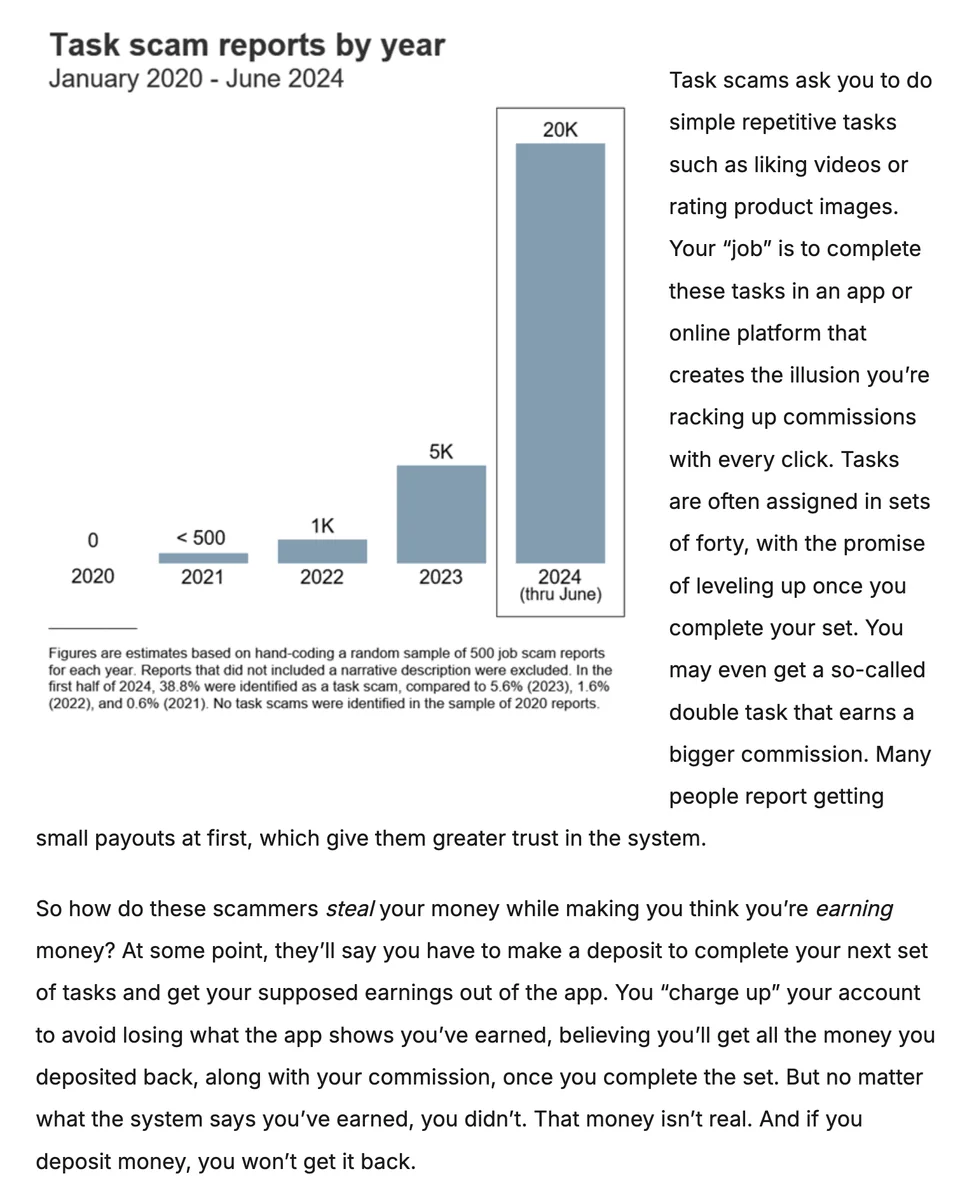
First, what these numbers cover: they come from consumer reports to the US FTC, so they reflect the situation in the United States. The FTC also notes that only a small share of people who are scammed report it, so the figures capture only part of the real harm.
With that in mind, a few figures stand out:
- Reported losses to job scams more than tripled from 2020 to 2023, and topped $220 million in the first half of 2024 alone.
- Task scam reports reached about 20,000 in the first half of 2024, up from about 5,000 in all of 2023. The FTC notes these are estimates, extrapolated from a random sample of 500 job scam reports hand-coded for each year.
- Job scam losses paid in cryptocurrency came to about $41 million in the first half of 2024, compared with about $21 million for all of 2023. The report says crypto now accounts for more job scam losses than any other payment method.
Already deposited? Do these things first
If the money is already in, getting the order right matters more than speed:
- Don't send another cent. However close they say you are to withdrawing everything, every payment from here on is a fresh loss.
- Keep your evidence complete: chat history, group chat logs, the app or web address, receiving addresses, and the time and transaction hash of every transfer you made. For what to save and how, follow the evidence steps for after a scam.
- Report it to your local police or an official anti-fraud channel. If your country has a national fraud hotline or online reporting service, use it. In the US, for example, you can report to the FTC at reportfraud.ftc.gov, and if you sent crypto, file a separate report with the FBI's IC3 at ic3.gov. If you're not sure who handles it where you live, start with the local police.
- Guard against a second hit. After a scam, people often show up offering to "recover" or "unfreeze" your money for an upfront fee. Treat every one of these as a second scam, and run what they tell you through our recovery-scam checker.
Common questions
I've already withdrawn from the platform a few times. Can it still be a scam?
Yes, and that's exactly the step it was built around. The FTC alert says scammers may pay you a little first, usually $5 to $20, to win your trust, and its data report says many people did receive small payouts at the start. Being able to withdraw a few dollars only shows the scammers are willing to spend that much to buy your trust. It doesn't show the platform can actually pay.
They say the deposit is only temporary and I'll get it back with commission after this set. Can I believe that?
No. The FTC data report describes that exact pitch: you top up so you won't lose the earnings the app shows, expecting to get your money back with commission once the set is done. But whatever the system says you've earned, that money isn't real, and what you deposited won't come back. The FTC treats being asked to pay before you can get paid as a sure sign of a scam.
Is it a problem just to get paid for liking videos or rating products?
Yes. The FTC advises against trusting anyone who says they'll pay you to rate or like things, says no legitimate company will do that, and its data report points to the FTC's 2024 fake-review rule, which makes paying for reviews and likes illegal for the businesses behind it. Either way, the job itself doesn't hold up.
My money is already in, and someone says they can get it back if I pay a fee first. What should I do?
Anyone who reaches out on their own, promises recovery and wants payment up front should be treated as a second scam. Stop making any further payments, keep your chat history, the receiving addresses and your transfer records, and report it to your local police or an official anti-fraud channel. You can also run their pitch through the recovery-scam checker on this site first.
any trading-fee discount is up to 20%, with the actual rate and eligibility subject to current OKX terms.
Keep reading
- Pig butchering and "trading mentor" scams—the same "let you withdraw once" logic, dressed up as romance.
- "AI trading bot" and arbitrage scams—another scheme that keeps you hooked with an earnings page only you get to see.
- I just got scammed: what now?—the order for stopping the loss, saving evidence and reporting.
- Scam self-check—run the message you received past the red flags in 30 seconds.